The Hidden Cost Most Consultants Don’t Track
You built your practice to do high-value work: advising clients, solving complex problems, building intellectual capital. But somewhere along the way, a significant chunk of your week got quietly reassigned — to inbox management, proposal formatting, scheduling, research compilation, invoice chasing, and the long tail of administrative work that keeps a solo or small consulting practice running.
It doesn’t feel like a crisis. It feels like Tuesday.
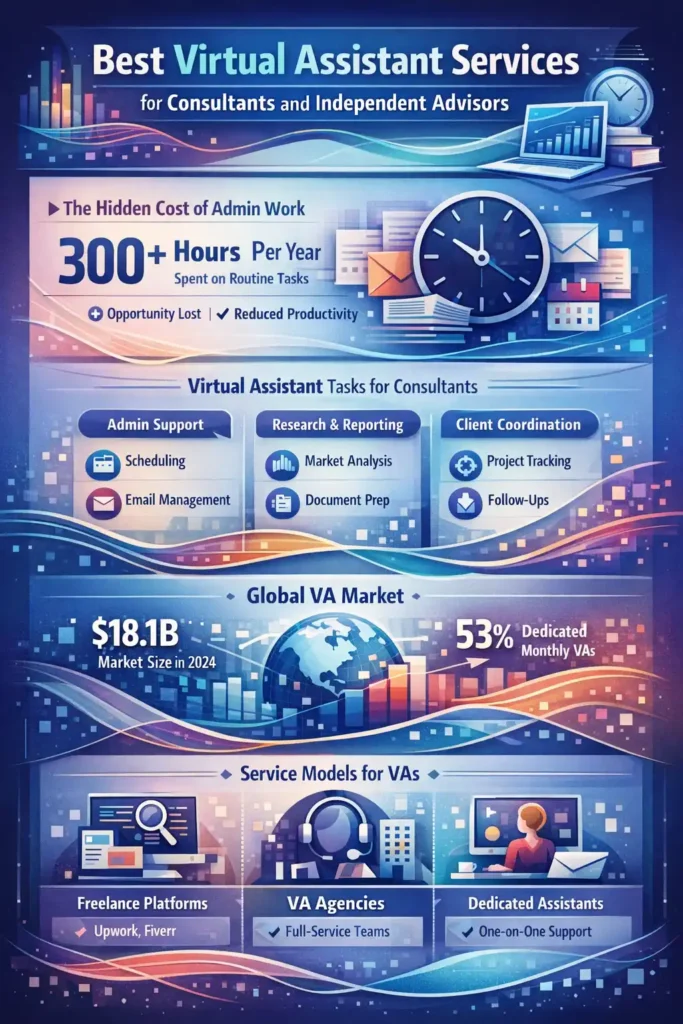
But the numbers are telling. According to a LinkedIn survey frequently cited in productivity research, business owners waste more than 300 hours per year on administrative tasks that don’t require their expertise. For a consultant billing at a professional rate, those hours carry a meaningful opportunity cost — work that isn’t getting done, clients who aren’t getting the attention they deserve, and deep-focus projects that stay perpetually half-finished.
The case for hiring a virtual assistant for consultants isn’t really about convenience. It’s about protecting the quality of your practice. This article walks through how consulting virtual assistant services work, what the best models look like, how to evaluate your options honestly, and what serious buyers get wrong when they start this process.
Infographic of Best Virtual Assistant Services for Consultants and Independent Advisors
What a Virtual Assistant for Consultants Actually Does
The term “virtual assistant” gets used loosely, which is part of the confusion. In the consumer context, it might refer to AI chatbots or voice tools. In the business context, it means something far more practical: a skilled professional who works remotely to handle tasks that keep your practice running but don’t require your direct involvement.
For consultants specifically, this distinction matters a great deal. A virtual assistant for consultants isn’t simply an offshore data entry operator or a general freelancer handling social media posts. The best VA relationships in professional services are built around someone who understands the cadence of consulting work — the proposal cycle, the client management rhythm, the reporting and research demands, the calendar complexity of client-facing professionals.
The scope of tasks is broader than most consultants initially expect.
On the administrative side: calendar management, meeting scheduling, inbox triage, travel booking, CRM updates, and expense tracking. On the research and documentation side: compiling market data, formatting reports, building presentation decks, organizing reference libraries, and managing version-controlled documents. On the client operations side: preparing briefing materials, following up on outstanding deliverables, tracking project milestones, and maintaining organized client records.
Some consultants also delegate more specialized tasks — light bookkeeping oversight, LinkedIn content scheduling, newsletter management, or onboarding support for new clients. The right scope depends entirely on how the individual practice is structured.
What makes consulting virtual assistant services distinct from general VA hiring is the level of professional context required. A consultant’s workflow is less predictable than a product company’s or an e-commerce brand’s. Priorities shift based on client demands. Confidentiality is often critical. Communication needs to be clear, professional, and often client-adjacent. Not every virtual assistant — and not every VA service model — can meet that standard.
Why this matters commercially
The global virtual assistant services market was valued at approximately $18.1 billion in 2024 and is projected to reach nearly $19.5 billion in 2025, according to industry analysis by Future Market Insights. Administrative VAs remain the dominant category, accounting for roughly 38% of market revenue. Dedicated monthly VA arrangements — where one professional supports a single client consistently — represent the largest service model, expected to hold more than 53% of market share in 2025. That model dominates for a reason: it mirrors how professional services relationships actually function. Consistency, contextual familiarity, and trust matter when you’re working inside someone’s confidential business operations.
For consultants evaluating this market, the headline isn’t the size of the industry — it’s the signal that businesses increasingly want stable, ongoing VA relationships rather than ad hoc task completion. That shift has meaningful implications for how you should structure your own arrangement.
How Consulting Virtual Assistant Services Work
Understanding the service mechanics helps consultants avoid the most common mismatches between what they expect and what they actually receive.
The three primary service models
Freelance marketplace platforms (Upwork, Fiverr, Toptal, and similar) give you direct access to a large pool of independent VAs. You post a job, review profiles, interview candidates, negotiate rates, and manage the relationship yourself. The range of available skills is wide; so is the range of quality. For a consultant who has time to properly vet and onboard a VA, and who wants a long-term working relationship with a specific person, this approach can work well — particularly for specialized tasks like presentation design or research. The tradeoff is that you carry the management overhead yourself.
Dedicated VA services (examples include BELAY, Time Etc, Boldly, and similar premium agencies) handle the matching and vetting for you. You describe your needs, and the service places you with a professional assistant who meets their quality criteria. These services tend to cost more, but they absorb the sourcing work and often provide backup coverage if your primary VA is unavailable. For consultants who want to delegate admin tasks without managing the hiring process, this is often the most efficient entry point.
Offshore managed teams offer higher task volume at lower per-hour costs, often across multiple time zones for near-24-hour coverage. The best of these services provide strong quality oversight; others are more variable. This model suits practices with predictable, process-driven workflows — but requires more robust documentation and communication structure to work well for professional services.
The onboarding reality
One thing many first-time VA buyers underestimate: the first four to eight weeks of any VA relationship are an investment, not an immediate return. You’ll need to document workflows, establish communication norms, provide context about your clients and practice, and build the trust layer that makes delegation feel natural. Firms that specialize in VA implementation note that structured onboarding — clear process documentation, access permissions, decision-making boundaries — significantly shortens the time before a VA relationship generates measurable time savings.
This is particularly relevant for consultants, whose workflows can be idiosyncratic and context-dependent. The more clearly you can articulate how your practice operates, the faster a virtual assistant can become genuinely useful.
Pricing mechanics
Rates vary significantly by model and geography. Managed US-based VA services typically operate on monthly retainer models starting around $1,500–$3,000 per month for part-time support. Offshore managed services can run considerably lower. Freelance marketplace rates span a wide range depending on skill level and location. The critical framing isn’t cost per hour — it’s value per recovered hour of your own time. For a consultant billing at $200–$500+ per hour, even recovering ten hours a month has a meaningful financial multiplier.
Use Cases: Where Consultants Get the Most Value
Not all consulting practices have the same administrative needs. The right VA use cases depend on your practice structure, client base, and personal bottlenecks. Here are five common scenarios where the return on a virtual assistant relationship is most reliably high.
1. The high-volume solo consultant
A strategy or management consultant who runs a solo practice while maintaining five to eight active clients simultaneously faces a structural problem: client deliverables crowd out client management. Scheduling slips. Follow-ups get delayed. Proposal templates need refreshing but there’s never a clean window to do it. A VA focused on calendar management, inbox triage, and client communications maintenance can recover eight to twelve hours per week for this type of practitioner — time that goes directly back into billable work or business development.
2. The independent financial or legal advisor
Advisors in regulated industries often carry significant document management burdens: compliance filings, client records, report formatting, meeting preparation materials. A detail-oriented VA with relevant experience in professional services — familiar with confidentiality norms and document accuracy standards — can handle the operational infrastructure that keeps an advisory practice organized. This is precisely where lower-quality VA arrangements fail: the required accuracy and discretion aren’t generic skills.
3. The boutique consulting firm (two to ten professionals)
Firms without a dedicated operations role often distribute administrative burden across their consultant team. Everyone ends up doing tasks beneath their professional level, which erodes morale and wastes expensive time. A shared VA arrangement — or a small dedicated support team — provides the administrative layer the firm needs without the cost or complexity of a full-time hire. Scheduling, coordination, document management, and internal operations all benefit from centralized, consistent support.
4. The researcher or knowledge-intensive consultant
Consultants who do primary or secondary research as a core part of their service — policy advisors, market entry strategists, competitive intelligence specialists — often spend disproportionate time on research compilation and formatting rather than analysis. A VA trained in research support can handle source gathering, citation management, data organization, and draft formatting, allowing the consultant to focus on interpretation and strategic framing. The leverage here is often higher than in pure administrative arrangements.
5. The consultant scaling toward productized services
When a consultant begins developing courses, frameworks, thought leadership content, or other productized offerings, the workload expands beyond what any one person can absorb alone. VAs skilled in content operations — scheduling, formatting, asset management, distribution logistics — can shoulder the operational weight of building a second revenue stream without requiring a full team hire.
Market Context: What’s Changed and What Buyers Are Discovering
The landscape for professional services support has shifted substantially over the last several years. Remote work normalization made the idea of a remote assistant feel natural where it once felt uncertain. Improved collaboration tools reduced the friction of asynchronous working relationships. And a growing cohort of highly qualified professionals — career executive assistants, former consulting operations managers, project coordinators — began operating as independent or agency-affiliated virtual assistants.
The net effect is that the quality ceiling for consulting virtual assistant services is considerably higher than it was five years ago. The best VA services today attract experienced professionals who understand professional services environments, can communicate with clients if required, and handle complex, judgment-dependent tasks — not just routine admin.
What serious buyers are discovering in practice
Consultants who have hired VAs report a common pattern: the first hire feels uncertain, the first month feels slow, and by month three the relationship feels indispensable. This arc is well-documented in the VA services market, where the dedicated monthly model dominates precisely because clients who push through the learning curve almost never go back.
The opposite pattern — hiring a VA, under-investing in onboarding, deciding it “didn’t work,” and returning to doing everything themselves — is equally common. The difference between these two outcomes almost always comes down to the quality of the onboarding investment, not the quality of the assistant.
Global talent dynamics
The availability of English-proficient, highly educated VA talent has grown significantly in markets like the Philippines, India, Eastern Europe, and Latin America. Managed VA services operating in these markets have invested heavily in training, quality oversight, and communication standards to close the gap with US- or UK-based providers. For consultants whose workflows are well-documented and who are comfortable with asynchronous communication, offshore managed services can deliver high quality at a materially lower cost point.
That said, geography matters in subtle ways for consulting work. Client-adjacent communications, where a VA might occasionally interact with your clients or send correspondence under your name, carry higher stakes and may warrant a higher-caliber, more culturally aligned assistant. The right match depends on your specific workflow, not a blanket rule.
The AI question
No honest treatment of this market can ignore the role of AI tools. Automation now handles a meaningful slice of tasks that VAs would previously have executed manually — basic research aggregation, template-based document generation, inbox summarization. The practical effect is not that human VAs are being displaced; it’s that the best VAs now use AI tools to do more, faster. When evaluating a VA service, understanding their tool stack and how they incorporate AI assistance is a legitimate question. A VA who uses these tools well is more productive, not less valuable.
What Serious Buyers Should Evaluate Before Hiring
When consultants move from curiosity to actual evaluation, the decision becomes more nuanced than a price comparison. Here is what the most important factors actually look like in practice.
Specialization and professional context
A VA who has supported consultants, advisors, or professional services firms before is materially different from one who has primarily worked in e-commerce or general small business administration. The norms are different: communication formality, document accuracy expectations, confidentiality instincts, and familiarity with consulting deliverable types. Ask directly about a service’s experience in professional services.
Vetting and quality standards
Managed VA services vary significantly in how rigorously they screen and train their assistants. Premium services run background checks, require demonstrated prior experience, and conduct structured onboarding for their own team members before placing them with clients. Some platforms are essentially marketplaces with limited quality control. Understanding what a service’s vetting process actually consists of is a reasonable part of any evaluation.
Confidentiality infrastructure
Consultants handle sensitive client information. NDAs are standard, but the more substantive question is whether the VA service has clear policies around data handling, platform security, communication confidentiality, and conflict of interest. For consultants working with clients in the same industry or competitive landscape, this deserves explicit discussion before engagement.
Communication structure and responsiveness
The single most consistent predictor of a good VA relationship is communication clarity — on both sides. Clear task briefs, defined turnaround expectations, a preferred communication channel, and a feedback mechanism. Evaluate prospective services not just on what they promise, but on how organized and specific their onboarding process is. A chaotic onboarding is usually a preview of a chaotic ongoing relationship.
Scalability and backup coverage
Solo freelance VAs offer a one-to-one relationship that can be warm and highly personalized, but they’re also single points of failure. When your VA is sick, on vacation, or leaves unexpectedly, the work doesn’t pause. Managed services that provide backup coverage and knowledge transfer processes are worth the premium for consultants whose operations depend on consistent support.
Trial arrangements
Most reputable managed services offer a trial period. Use it. The matching process, however good, is imperfect. How a service handles a mismatch — whether they offer rematch options, provide feedback loops, and treat the onboarding period as a genuine evaluation window — says more about its quality than its marketing materials do.
Common Mistakes and Misconceptions
Despite the clear value proposition, many consultants who try VA services don’t capture the full benefit — and a meaningful number abandon the arrangement prematurely. These are the most frequent errors.
Delegating the wrong tasks first
The instinct is often to hand off the most visible, annoying tasks immediately. But the highest-value delegation is usually the most repeatable, processable work: inbox sorting rules, calendar management, standard document formatting, CRM hygiene. Starting with high-volume routine tasks builds shared context, establishes trust, and creates the foundation for more complex delegation over time. Handing a VA complex, judgment-heavy tasks before that foundation exists typically leads to frustration.
Skipping documentation
A VA cannot read your mind. If your preferred communication tone, document format, client management approach, and task prioritization logic lives only in your head, you will spend more time correcting work than delegating it. Brief, written process documentation — even rough notes — dramatically accelerates the value curve of any VA relationship. This is the most commonly skipped step and the most costly omission.
Conflating price with value
The cheapest VA service is rarely the best deal for a professional services practice. A low-cost VA who requires constant correction, produces inconsistent output, or lacks the professional context to work in a consulting environment may cost more in management time than a premium-tier service would have cost in fees. Evaluate on total cost of engagement: fee plus your time investment.
Assuming a single hire solves every problem
Some consultants hire a VA expecting a comprehensive transformation of their operations. In reality, a single VA — especially part-time — handles a defined scope of tasks. Matching expectations to the actual scope of engagement is important. The right framing is: what specific, recurring time drain will this hire address? Starting there produces better outcomes than starting with vague hopes for general efficiency.
Neglecting the relationship
Virtual doesn’t mean impersonal. The consultants who get the most from VA relationships invest in regular check-ins, provide genuine feedback, explain context when priorities shift, and treat the assistant as a professional rather than a task queue. This isn’t just about being a good client — it’s the practical mechanism by which a VA learns enough about your practice to exercise good judgment independently.
How to Make the Right Decision for Your Practice
If you’ve read this far, you’re past the question of whether a virtual assistant for consultants makes sense. The real question is how to approach the decision without wasting time on a bad fit.
Start by auditing your own week. Identify the tasks that consistently take more time than they should, that don’t require your expertise, and that follow predictable enough patterns that someone else could learn to handle them. Document those tasks — even briefly. That documentation becomes the foundation of a clear brief for any VA service you approach.
Next, match the service model to your actual situation. If you want someone who understands professional services environments and can begin working with minimal handholding, a premium managed service with demonstrated consulting sector experience is the most efficient path. If you have time to vet and onboard your own candidate, a freelance platform gives you more control and flexibility. If budget is the primary constraint and your workflows are highly documented, a quality offshore managed service may offer the best combination of cost and consistency.
When evaluating specific services, the questions that matter most aren’t about features — they’re about fit. Has this service supported consulting practices specifically? What does their onboarding process look like? How do they handle quality issues? What’s their policy on data handling and confidentiality?
The goal isn’t to find the most impressive VA service. It’s to find the right level of support for your current practice, at a cost structure that makes sense, delivered by a service that understands your professional context.
When you delegate admin tasks effectively — not just theoretically, but in the daily operational reality of how your week runs — the recovered time has a compounding effect. Client work improves. Business development resumes. The deep-focus projects that have been deferred actually get started. That’s the real promise of a well-matched virtual assistant for consultants: not just less work on your plate, but better work getting done.
If you’re considering a consulting virtual assistant service and want to understand whether your practice is the right fit, the clearest starting point is a conversation with a service that takes the matching process seriously. The best providers will ask good questions before they offer answers — and that’s exactly what you should expect.