When “Good Enough” Becomes a Business Problem
There is a specific kind of frustration that professionals rarely talk about openly: the slow erosion of capacity caused not by a single disaster, but by a hundred small inaccuracies — a scheduling mistake that costs a client meeting, a data entry error that delays a report, a misrouted email that holds up a contract. None of these failures is dramatic. Each one is easy to explain away. Together, they quietly erode the precision that service-based professionals and growing businesses depend on.
This is the real argument for virtual assistant services — not the promise of “more time,” which has become something of a marketing cliché, but the more specific and commercially serious case for accuracy in high-stakes administrative workflows. Founders, consultants, researchers, agencies, and executives increasingly need support that is both reliable and detail-oriented. Guesswork, in any form, is a liability they cannot afford.
The question is not whether to delegate. For any professional operating above a certain level of complexity, delegation is not optional. The question is how to delegate well — which assistant model fits the work, what standards of quality to require, and what to look for in a service provider before handing over sensitive processes. That is what this article is designed to answer.
What Virtual Assistant Services Actually Mean — and Why the Definition Matters
The phrase “virtual assistant services” covers a wide spectrum of support. At one end: task-based freelance work delivered through gig platforms, where a professional posts a request and receives completed work from an unvetted contractor. At the other end: structured, managed administrative support services delivered by a vetted specialist — someone embedded in your workflows, trained on your systems, and held to documented quality standards by a professional services provider.
These two things share a label. They do not share a use case.
For professionals managing document-heavy workflows — legal correspondence, research coordination, client onboarding, report preparation, financial data entry — the distinction matters enormously. A misformatted contract is more than an inconvenience. A wrongly scheduled meeting across time zones can cost a consulting engagement. An error in a research database undermines months of work. For these professionals, virtual assistant services are not a productivity hack. They are an operational dependency, and they need to be structured accordingly.
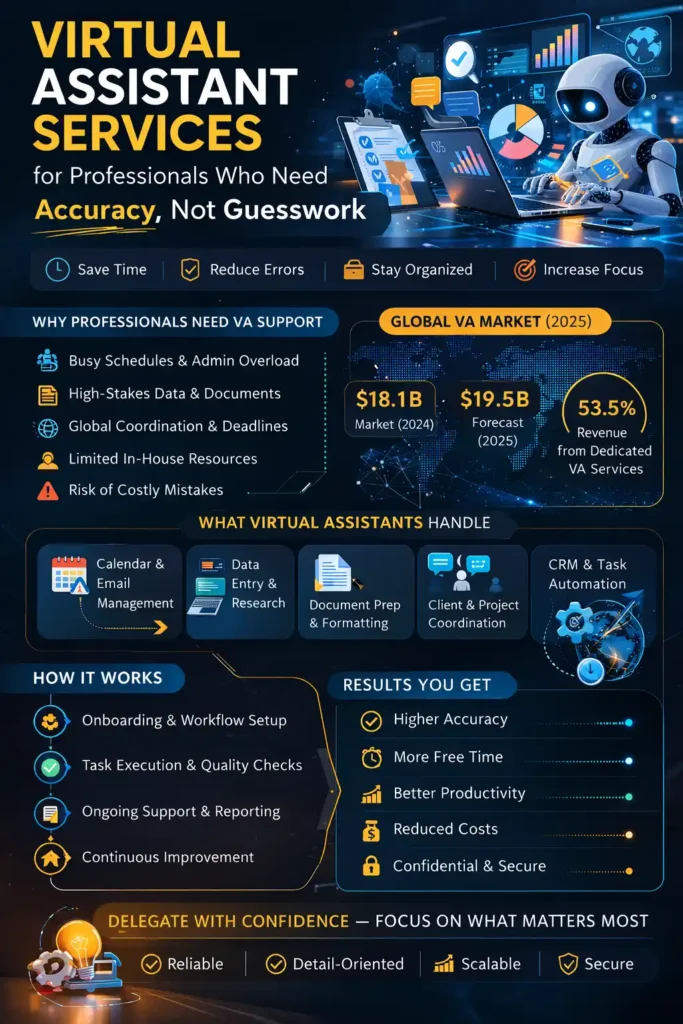
The global virtual assistant services market reflects this growing seriousness. The market grew from roughly USD 12.3 billion in 2020 to USD 18.1 billion in 2024, with demand forecast to reach USD 19.5 billion in 2025. That growth is not driven by solo entrepreneurs outsourcing a few admin tasks. It is driven by organizations — small, mid-sized, and enterprise — that have recognized the operational and cost case for structured administrative support.
Within that market, the dedicated monthly VA segment is expected to generate 53.5% of market revenue in 2025 — a signal that buyers are moving away from gig-based, transactional models toward ongoing professional relationships with clear accountability.
This matters for how you evaluate options. The right question is not “Can I find someone to do this task?” but “Can I find a service model that makes delegation safe for work where accuracy is non-negotiable?”
Defining that more precisely: administrative support services at the professional level typically include calendar and inbox management, research and data compilation, document preparation and formatting, coordination with clients or vendors, scheduling across time zones, and CRM management. These are not simple tasks. Done poorly, each one creates downstream errors. Done well, each one removes a specific category of operational friction that consumes professional capacity.
The businesses that benefit most from virtual assistant services are those with recurring, process-dependent administrative work. One-off tasks with low stakes are fine for gig platforms. Recurring workflows that touch clients, contracts, financial data, or reputation require something more structured — and that requires knowing the difference between service models before you commit to one.
How Professional Virtual Assistant Services Work: Structure, Process, and What to Expect
The fundamental difference between a professional virtual assistant service and an ad hoc arrangement is process. Structured services — whether delivered by a virtual assistant agency or a managed service provider — operate with documented workflows, defined response protocols, onboarding procedures, and quality checkpoints. The work is traceable. Errors are flagged and corrected. Performance is reviewed.
Here is what that typically looks like in practice:
Onboarding. A quality service provider starts by mapping your workflows — what recurring tasks exist, what tools you use, what communication norms apply, and where precision is most critical. This phase usually takes one to two weeks. Leading VA agencies report onboarding timelines of one to two weeks for basic administrative roles and two to four weeks for specialized positions. Shorter is not always better. A provider that skips the mapping phase and starts work immediately may be optimizing for speed over fit.
Task assignment and documentation. Professional services maintain process documentation — standard operating procedures (SOPs) for your specific workflow. If your primary assistant is unavailable, a documented process means a backup assistant can continue without starting from scratch. This is one of the clearest structural differences between a managed service and a freelance hire: continuity of knowledge regardless of personnel changes.
Quality assurance. Reputable providers build in review mechanisms — either internal checks before deliverables reach you, or defined revision protocols when errors occur. For accuracy-sensitive work, this is not a luxury; it is the minimum standard.
Communication protocols. Good services establish clear channels, response time commitments, and escalation paths. You should know, before you start, how to reach your assistant, how quickly to expect responses, and who to contact if something is urgent.
Confidentiality frameworks. Professional virtual assistant services operate under non-disclosure agreements, data handling policies, and access controls. If a provider cannot clearly explain how it manages client confidentiality, that is a disqualifying sign for any work involving sensitive business information.
What this structure enables is delegating with confidence rather than delegating and following up anxiously to check if it was done right. The value is not just the hours saved — it is the cognitive overhead removed by knowing that a professional is following a documented process, not guessing at what you need.
Infographic of Virtual Assistant Services for Professionals Who Need Accuracy, Not Guesswork
Who Benefits Most: Use Cases Where Accuracy-Focused Virtual Assistance Delivers Real Returns
Not every professional needs the same level of administrative support, and not every use case justifies the same service model. The following scenarios represent the clearest cases for structured virtual assistant services — situations where the cost of inaccuracy is high and the volume of administrative work is sustained, not occasional.
Consultants and Independent Advisors
A management consultant or strategy advisor working with multiple clients simultaneously faces a specific administrative burden: keeping client communications, deliverables, and scheduling separate, accurate, and professional. A missed follow-up damages a client relationship. A document sent to the wrong recipient is a confidentiality breach. These professionals need a virtual assistant who operates with the same discretion and precision that the consultant themselves applies to client work.
The common model here is a dedicated assistant who manages email triage, client calendar coordination, meeting preparation, and document formatting — freeing the consultant to stay in advisory mode rather than administrative mode for most of the working week.
Founders and Small Business Owners
Small businesses represent a significant share of virtual assistant services demand. Small and medium businesses captured 44.4% of the VA market in 2025, drawn to cost-optimized outsourcing and flexible headcounts. For a founder managing sales, operations, and client delivery simultaneously, administrative overhead is a direct tax on growth capacity. The specific risk for founders is context-switching: the mental cost of shifting from high-value strategic work to administrative tasks is not trivial, and the administrative tasks often get done hurriedly, inaccurately, or not at all.
Structured administrative support services let founders delegate recurring work — inbox management, expense tracking, vendor coordination, report preparation — with clear protocols, without the cost and overhead of a full-time hire.
Researchers and Academic Professionals
Research workflows have a low tolerance for inaccuracy. Literature search coordination, reference management, data collation, and manuscript formatting all require careful, methodical attention. A virtual assistant with experience in research support can handle these tasks reliably — provided the service provider has matched them to someone with the appropriate background.
This use case illustrates a point worth making explicitly: the quality of the match between the professional’s specific requirements and the assistant’s actual skill set matters more than the general reputation of the service. A strong virtual assistant agency will invest time in this matching process. A weak one will assign the nearest available person and move on.
Executives Managing High-Volume Communication
Senior executives often cite email and calendar management as their largest time sinks. Professionals spend about three hours a day managing email, and sales leaders spend just one-third of their time on actual selling. These are recoverable hours — but only if the person handling communications can operate with judgment, discretion, and accuracy. Misread priorities, missed context, or careless replies in a senior executive’s name are not acceptable errors.
The executive support model typically involves a dedicated assistant who learns the executive’s communication style, manages scheduling across complex time zones, prepares briefing materials before meetings, and ensures nothing critical slips through the cracks.
Agencies and Professional Services Firms
Agencies running multiple client accounts need consistent, accurate administrative and operational support at scale. Project coordination, deadline tracking, client reporting, and resource scheduling all involve processes where small errors compound into larger service failures. A virtual assistant agency that can staff and manage this kind of support — with defined quality standards and backup coverage — becomes a genuine operational asset.
Market Context: What Professional Buyers Are Actually Choosing
The virtual assistant market has matured considerably in the past five years. Early adopters were primarily solopreneurs seeking cheap task coverage. The current buyer profile is more sophisticated — and more demanding.
Approximately 54% of companies use virtual assistants for administrative support, while 42% rely on them for project management tasks. The administrative role remains dominant, but the profile of what “administrative support” means has shifted upward. Buyers are not just looking for data entry and scheduling. They want assistants who can work within complex systems, handle sensitive information responsibly, and apply judgment to ambiguous situations.
This has shifted the competitive dynamics of the market. Established VA providers controlling nearly 70% of revenue have focused on premium, dedicated monthly VA models for operational support across SMBs and enterprises, with competitive differentiation relying on quality, specialization, responsiveness, and cost efficiency.
The pricing landscape reflects this. virtual assistant agency pricing ranges from roughly $140 per month for basic support to $2,995 per month for premium executive services, with entry-level administrative support typically costing $15–25 per hour and specialized services commanding $25–50 per hour through professional agencies.
That range signals something important for buyers: price alone is not a reliable proxy for quality. A $15/hour freelancer on a gig platform and a $15/hour assistant placed through a vetted agency are not equivalent products. The agency model includes screening, training, quality assurance infrastructure, and backup coverage — none of which appears in the hourly rate but all of which determine whether the work actually meets professional standards.
The choice between a freelance model and a virtual assistant agency model is one of the most consequential decisions a professional buyer makes, and it is worth examining honestly.
The freelance model offers flexibility, lower cost, and direct control over the selection process. It works well for specific, bounded tasks where the professional has time to vet candidates, manage the relationship, and absorb the occasional reliability gap. It works poorly for recurring, high-stakes work where continuity matters and errors carry real costs.
The agency model offers vetting, structural accountability, backup coverage, and a managed relationship. Each virtual assistant placed through an agency has been screened, interviewed, and vetted — and the VA-client matching service itself is typically included in the arrangement. The trade-off is higher cost and sometimes less flexibility in how the relationship is structured.
VA companies provide a structured approach to remote assistance, offering services from administrative support to specialized tasks, with a team of vetted professionals ensuring that assistance is available regardless of individual availability.
For professionals with accuracy-sensitive workflows, the structural accountability of an agency model typically justifies the cost premium. The question is not which model is cheaper — it is which model makes the work reliable enough to delegate without constant oversight.
What Serious Buyers Should Evaluate Before Committing
Hiring professional virtual assistant services is not a purchase decision in the conventional sense. It is closer to building an operational dependency — and the factors that matter are different from what most buyers focus on initially.
Specialization match. The most common source of disappointment in virtual assistant relationships is a mismatch between the assistant’s actual skills and the buyer’s specific requirements. A generalist assistant is well suited for general administrative work. A professional whose work involves legal correspondence, financial data, research coordination, or technical documentation needs an assistant with relevant background. A quality provider will ask about your specific workflows before matching you with someone. If they do not, that is a warning sign.
Confidentiality infrastructure. Any serious virtual assistant service should operate under NDAs, with defined data access controls and clear policies on how client information is handled, stored, and protected. This is non-negotiable for professionals in legal, financial, medical, or corporate advisory contexts. Ask specifically: how is client data stored? Who has access to it? What happens to it when the relationship ends?
Continuity planning. What happens when your assistant is sick, on leave, or leaves the service? A professional provider has a documented answer to this question. A freelance hire typically does not. For recurring workflows, the absence of continuity planning is a structural risk.
Communication standards. Response time commitments, escalation paths, and preferred communication channels should be defined before work begins, not discovered after the first missed message. Quality providers establish these expectations during onboarding.
Quality review mechanisms. How does the service catch and correct errors? Is there an internal review process before deliverables reach you? Is there a protocol for raising quality concerns without damaging the relationship? These questions reveal whether a provider has invested in quality infrastructure or is relying on the assistant’s individual judgment.
Pricing structure and scalability. Predictable pricing matters for planning. Variable hourly arrangements work for some professionals, while monthly retainer models work better for others. Understand exactly what is included — and what triggers additional charges — before committing to a contract.
Trial period and exit terms. Reputable providers offer some form of trial or satisfaction guarantee. Contracts with punitive exit terms for short arrangements are a structural red flag. The service should be confident enough in its quality to let the relationship prove itself.
Common Mistakes and Misconceptions That Cost Professionals Time and Money
The virtual assistant market has enough noise around it that several persistent misconceptions affect how professionals approach hiring decisions. Understanding these is useful before making a commitment.
“Any VA can handle any task.” The most expensive misconception in this space. Virtual assistants vary enormously in background, skill level, and experience with specific workflow types. Hiring a generalist VA for specialized, accuracy-critical work — and then discovering the mismatch three weeks in — wastes both time and money. Match the assistant’s demonstrated capabilities to the specific work, not to a general description of “administrative support.”
“Cheaper is always better for support work.” Support work has a quality floor below which it stops saving you time and starts creating new problems to fix. An assistant who produces work requiring significant revision or correction is not saving you time — they are adding a review layer to your already-full schedule. The relevant calculation is cost per reliably completed task, not cost per hour.
“I’ll delegate once I have time to set it up properly.” This is one of the more ironic traps in delegation. The professionals who most need support are often the ones most reluctant to invest the setup time. A good service provider handles the setup. Your role is to answer questions during onboarding — not to build the systems from scratch. Waiting for the right moment to delegate usually means waiting indefinitely.
“Confidentiality is handled by the platform.” Platforms do not guarantee confidentiality in the way professional service agreements do. If your work involves sensitive client information, proprietary research, financial data, or anything that would be damaging if disclosed, you need explicit contractual protections — NDAs signed by the specific assistant handling your work, not general platform terms of service.
“I should find the cheapest option and see how it goes.” Testing quality with your actual sensitive work is a high-cost experiment. The value of a trial period with a quality provider is that it lets you evaluate the service on real work without a long-term commitment. That is a meaningfully different risk profile from sourcing the cheapest available option and hoping it works.
“Virtual assistants can only do simple tasks.” The market has moved well past this. Experienced VAs working within managed service models handle complex scheduling across executive teams, multilingual correspondence, research database management, financial reconciliation, and project coordination. The ceiling on what skilled virtual assistant services can handle has risen considerably as the professional talent pool and service infrastructure have developed.
Practical Guidance for Professionals Ready to Make a Decision
If your workflows have reached the point where administrative overhead is measurably slowing you down, or where small errors are creating downstream problems that you cannot afford, structured virtual assistant services are worth serious evaluation — not as an experiment, but as an operational investment.
The clearest starting point is an honest audit of where your time actually goes. Most professionals who start this exercise discover that a significant portion of their week is absorbed by tasks that are necessary but not high-value — tasks that could be delegated without risk if handled by the right person within the right service structure.
The second step is specificity. Do not approach a provider with a vague request for “help with admin.” Define the recurring tasks, the tools involved, the accuracy standards required, and the confidentiality sensitivity of the work. A quality provider will use this information to match you with someone appropriate. A poor provider will assign whoever is available.
For accuracy-sensitive, document-heavy, or client-facing workflows, a VA agency or managed service provides the structure most suited to consistent, high-quality administrative support — particularly when your work involves sensitive data or compliance considerations. The additional structure is not bureaucracy; it is risk management.
For lower-stakes, variable work with simple tasks, a carefully vetted freelance arrangement may be sufficient and more cost-effective.
The professionals who get the most from virtual assistant services — those who describe it as genuinely changing how they operate — share one common characteristic: they treated the setup as seriously as they would any other operational decision. They defined the work clearly, chose a service provider based on structural quality rather than price alone, invested in a proper onboarding, and built a working relationship that improved over time.
Good administrative support services do not just remove tasks from your plate. They create the conditions for more consistent, reliable, and professional output across everything your business touches. For professionals for whom reputation, accuracy, and client confidence are core assets, that is not a small thing.