You find someone on Upwork who looks perfect. The portfolio is solid, the reviews are decent, the rate is reasonable. You spend a week onboarding them, share your systems and workflows, and then — three weeks in — they go quiet. No explanation. No handover. Just silence, and a pile of half-finished tasks that were never documented.
This scenario is more common than most founders like to admit. The decision to hire a virtual assistant is often driven by urgency: you are stretched thin, deadlines are accumulating, and the cheapest solution that requires the least upfront effort seems like the smartest move. Freelance platforms make it easy to move quickly. But moving quickly and hiring well are not the same thing.
The comparison between a freelance virtual assistant and a boutique virtual assistant agency is not really about price. It is about what happens before the work starts, during the engagement, and after something goes wrong. This article breaks down those differences clearly so that founders, consultants, and executives who need reliable, ongoing support can make a more informed decision before committing to either option.
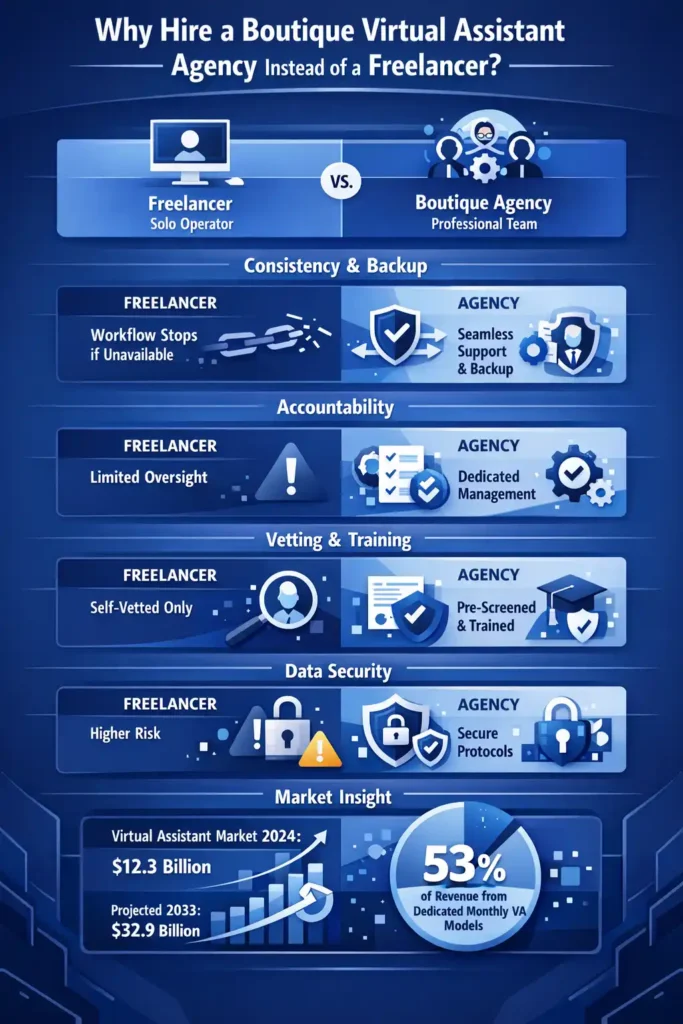
Infographic Why Hire a Boutique Virtual Assistant Agency Instead of a Freelancer?
What Makes a Boutique Virtual Assistant Agency Different from a Freelancer?
To understand why the choice matters, it helps to be precise about what each model actually involves.
A freelance virtual assistant is an independent contractor who works for themselves. They set their own hours, manage their own clients, and operate without any employer-level oversight. When you hire a freelancer, you are entering into a direct relationship with one individual. Everything depends on that person: their availability, their skills, their reliability, their discretion, and their commitment to your work over the work of their other clients.
A boutique virtual assistant agency is a small, professionally managed service firm that employs or contracts a curated team of VAs. The word boutique matters here. It signals a deliberate approach to quality control, client relationships, and specialization that is distinct from large-scale VA platforms or offshore staffing mills. Boutique agencies typically serve a smaller client base, take more care in matching clients to the right assistants, and operate with formal management structures, quality oversight, and defined accountability.
The distinction sounds straightforward, but the practical implications run deep. Consider a few dimensions:
Continuity. When a freelancer becomes unavailable — whether through illness, a better opportunity, or simply losing interest — your workflow stops. A boutique agency typically has backup coverage and structured handover processes so that work continues without disruption.
Accountability. With a freelancer, your primary recourse if work quality drops is to escalate a dispute on a platform or walk away and start over. With a well-run agency, you have a relationship with a team lead or account manager who is responsible for the outcome, not just the individual assistant.
Vetting and training. Freelance platforms publish profiles and reviews, but the vetting process is largely yours to conduct. Agencies pre-screen their assistants, often train them in standard operating procedures, and are selective about who they place with clients. You inherit that due diligence rather than performing it from scratch.
Confidentiality and data security. This is underappreciated until something goes wrong. When you hire a virtual assistant to handle email, scheduling, financial records, or client data, you are granting access to sensitive business information. An agency operating professionally will have NDAs, data-handling policies, and security protocols in place as standard. A freelancer operating alone often does not.
The global virtual assistant services market was valued at approximately $12.3 billion in 2024 and is projected to grow to $32.9 billion by 2033, according to market research cited by multiple industry analysts. Within that growth, the dedicated monthly VA model — which aligns closely with how boutique agencies structure their engagements — was expected to account for more than 53% of market revenue in 2025. This is not a coincidence. Businesses that have tried both models tend to converge on structured, ongoing support arrangements.
How to Hire a Virtual Assistant Through an Agency vs. a Freelancer Platform
Understanding the mechanics of each approach helps clarify where the real differences in risk and quality emerge.
The Freelancer Route
Hiring a freelancer typically starts on a platform like Upwork, Fiverr, or OnlineJobs.ph. You write a job description, review applications, assess profiles and reviews, conduct a brief interview, and make a hire. You negotiate rates, agree on a scope of work, and set up communication through the platform or a separate channel.
The process is fast and gives you direct control. For short-term, well-defined tasks — a one-time research project, a database cleanup, a specific content batch — this model works well. The cost is often lower than an agency. You deal directly with the person doing the work, and you can course-correct quickly if something is off.
The problems tend to surface over time. You are essentially a solo recruiter and manager. Vetting is your responsibility. Onboarding is your responsibility. If the quality dips or the freelancer disappears, replacing them means restarting the process: new job post, new applications, new screening, new onboarding, new ramp-up time. This cost is often invisible until it is experienced.
The Agency Route
Working with a boutique virtual assistant agency typically involves an initial consultation to understand your workflow, the nature of your tasks, and the type of support you need. The agency matches you with an assistant from their existing team based on skill alignment and availability. In better-run agencies, this matching process is thoughtful rather than just filling an open slot.
Onboarding is a shared process. The agency helps structure the engagement, provides their own operational frameworks, and often assigns an account manager who is your ongoing point of contact. Rates are generally higher than freelance platforms because the agency is absorbing the management overhead, providing backup coverage, and taking responsibility for outcomes.
Pricing for agency-provided virtual assistant services typically ranges between $15 and $50 per hour at the higher end, depending on specialization and the market the agency operates in, compared to significantly lower rates for offshore freelancers. But the true cost comparison requires accounting for the time you invest in finding, vetting, onboarding, and managing a freelancer yourself — time that has its own measurable value, particularly for senior professionals and executives.
What the Matching Process Actually Involves
In a high-quality boutique agency, the intake process asks substantive questions. What kind of tasks need delegation? What tools does your team use? What communication style works best for you? Are there confidentiality requirements? What does success look like in three months?
These questions exist because the right assistant for an investment firm running document-heavy due diligence workflows is not the same as the right assistant for a marketing consultant managing client deliverables. Boutique agencies make this distinction. General freelance platforms largely leave it to you.
Virtual Assistant Services by Use Case: When an Agency Outperforms a Freelancer
Neither model is universally superior. The more important question is: what type of support do you need, and what are the consequences if something goes wrong?
1. Executive and Administrative Support for Founders
Founders and CEOs who need ongoing calendar management, inbox triage, travel coordination, and executive communication support are hiring for trust and continuity as much as for capability. A well-matched VA at a boutique agency often develops deep contextual knowledge of the executive’s priorities, communication style, and key relationships over time. This institutional knowledge has real value.
With a freelancer, this knowledge belongs to one person. The day they leave, it leaves with them. Agencies mitigate this by maintaining structured notes, onboarding documentation, and backup coverage.
2. Document-Heavy and High-Accuracy Workflows
Consultants, researchers, law firms, and financial professionals often need VA support for tasks where accuracy is non-negotiable: formatting reports, managing research databases, transcribing or summarizing complex documents, handling compliance-adjacent administrative work. The tolerance for error in these environments is low.
Boutique agencies that specialize in professional services know how to recruit, vet, and train for this profile. A generic freelancer marketplace search yields variable results, and the screening burden falls entirely on you.
3. Client-Facing Communication and Customer Support
If your virtual assistant will handle any communication with your clients — responding to inquiries, managing scheduling requests, following up on deliverables — the professional quality of their communication directly represents your brand. Agencies typically screen for written communication quality and train for professional tone. They also have supervisory layers to catch errors before they reach clients.
4. Scaling Support Across a Small Team or Agency
Small agencies and consulting firms often need VA support that can flex — more hours during a busy client phase, lighter support during a quiet period. Boutique VA agencies are built for this model: their account managers can increase or decrease hours, bring in a specialist for a specific project, or reassign tasks as team needs shift. A freelancer can scale their hours within their own capacity, but they cannot bring in additional specialists or provide coverage when they are unavailable.
5. Sensitive Data Environments
Any business that handles regulated data, confidential client information, or proprietary business intelligence should treat the security posture of their virtual assistant as a non-trivial consideration. As one cybersecurity analysis noted, the risk of an information security incident is materially greater when working with freelancers who operate from home networks without enterprise-grade protections. Established agencies address this through background checks, NDA frameworks, managed device policies, and defined access protocols.
Market Context: How the Virtual Assistant Services Landscape Has Evolved
The decision to hire a virtual assistant has shifted from a niche outsourcing tactic to a mainstream operational strategy. According to industry data, more than 67% of businesses globally were integrating virtual assistants into daily operations by 2024. Approximately 49% of companies using VAs employ more than 1,000 people, which dispels the notion that this is a solo-entrepreneur solution. Enterprise workflows have quietly absorbed virtual assistant services at scale.
This broader adoption has also made the quality differentiation between models more pronounced. In the early years of the gig economy, the freelance VA was a novelty — a relatively uncontested option for anyone willing to experiment with remote delegation. Now, with a large and visible market, buyers have more context. They have also experienced more failures.
The rise of boutique virtual assistant agencies over the past several years reflects a buyer-led correction. Founders and executives who burned time on poor freelance matches started looking for more structured alternatives. The boutique model emerged as a middle ground: more personal and specialized than large-scale VA platforms, more accountable than an individual freelancer, and calibrated toward clients who value quality over lowest-unit-cost.
This trend is visible in market structure data. The dedicated monthly VA segment — the pricing model that boutique agencies typically use — was projected to generate more than half of global virtual assistant services revenue in 2025. Subscription-based engagements that offer predictable outcomes and ongoing relationships have become the preferred model for serious buyers. The pay-per-task gig model, while still viable for short-term needs, has receded as a primary support strategy for businesses with consistent workflow demands.
The Offshore Freelancer Dynamic
A significant share of freelance VA hiring involves offshore talent, particularly from the Philippines, India, and parts of Latin America, where hourly rates are considerably lower than in Western markets. This is a legitimate and often effective strategy when managed well. The appeal is clear: skilled professionals at a fraction of the local cost.
The challenge is that the offshore freelancer model concentrates risk. Time zone management, communication clarity, and continuity all require more active involvement from the client. The cost savings can evaporate if you factor in the management overhead, the quality control effort, and the disruption of replacing someone in a different time zone.
Boutique agencies that operate internationally often solve this by maintaining management layers in the client’s time zone while sourcing execution talent globally. The client gets the cost efficiency of international talent without bearing all the operational risk themselves.
What Buyers Actually Worry About
Conversations with business owners across the virtual assistant services market reveal consistent anxieties that go beyond the basic price comparison. The top concerns are usually some variation of: Can I trust this person with my data? What happens if they disappear? Will the quality be consistent? Will they understand my industry?
Boutique agencies are structured specifically to address these concerns at a systemic level rather than leaving them to chance. The quality of any individual freelancer may be excellent — and many founder-freelancer relationships are genuinely productive over the long term — but the risk profile is fundamentally different. When the stakes are high and the workflow is ongoing, buyers tend to prefer the model where accountability is built in.
What to Evaluate Before You Hire a Virtual Assistant Through Any Channel
Whether you are considering an agency or a freelancer, the criteria for a good hire are more nuanced than most initial checklists suggest. Here is what experienced buyers consistently look for:
Depth of Vetting and Transparency
A boutique agency should be willing to explain their screening process in detail. How do they assess candidates? What technical and soft skill evaluations do they use? What does their background check process involve? If an agency cannot articulate this clearly, treat it as a warning sign. Good agencies are proud of their process.
With freelancers, the vetting is yours to own. This means going beyond platform reviews: conducting your own structured interviews, requesting work samples relevant to your actual tasks, checking references, and running a paid trial before committing to a longer engagement.
Data Security and Confidentiality Infrastructure
Before sharing any sensitive information with a virtual assistant, understand what protections are in place. Does the agency have signed NDAs with its assistants? Are assistants working on company-issued devices or personal computers? What password management and access control practices are in place?
Security researcher and consultant perspectives on this topic are unambiguous: freelancers operating from home networks on personal devices present a materially different risk profile than assistants working within a managed service that enforces security protocols. This does not mean freelancers are untrustworthy — many are meticulous — but it does mean the structural safeguards differ significantly.
Communication Quality and Responsiveness
The quality of a VA relationship lives or dies on communication. Before committing, pay attention to how the agency or freelancer communicates during the sales and onboarding process. Do they ask good questions? Do they follow up consistently? Is their written communication professional? These signals are highly predictive of the working relationship.
Backup and Business Continuity
Ask directly: what happens if my assigned assistant is unavailable? A well-run boutique agency has a clear answer. There is a backup assistant, a documented handover process, and a management layer that ensures continuity. A freelancer’s answer will usually be a variation of: it depends on the circumstances. That may be acceptable for low-stakes tasks. For time-sensitive or client-facing work, it is not.
Cultural and Industry Fit
Better boutique agencies understand that cultural alignment and industry familiarity matter. An assistant who has worked extensively with professional services firms will adapt more quickly to an advisory practice than one whose background is entirely in e-commerce operations. Boutique agencies that specialize in a vertical or professional category can make this matching more precise.
Pricing Clarity and Contractual Terms
Understand exactly what you are paying for. Agency pricing often includes management oversight, quality control, training, and backup coverage — costs that are invisible when hiring a freelancer but very real when managed in-house. Ask agencies to be specific about what their fee includes and what it does not.
For freelancers, project-based pricing can be deceptively economical until scope creep or miscommunication emerges. Clear scoping and written agreements are essential regardless of the channel.
Common Mistakes When Hiring Virtual Assistant Services
Even buyers who understand the agency-versus-freelancer distinction make avoidable errors. These are the most frequent ones:
Optimizing for the Lowest Hourly Rate
Rate is a relevant input but a poor primary criterion. A highly skilled, reliable VA at $25 per hour who requires minimal management, maintains excellent quality, and stays with you for two years delivers far more value than a $10 per hour freelancer who requires constant oversight, produces inconsistent work, and leaves after three months. The total cost of ownership includes your time, the cost of errors, and the disruption of replacing someone.
Skipping the Onboarding Investment
Virtual assistants — whether through an agency or hired independently — perform better when they have clear context, documented procedures, and defined expectations. Many clients who describe disappointing VA experiences, on reflection, provided minimal onboarding and expected the assistant to operate autonomously from day one. No assistant, however skilled, can make good decisions without understanding your standards, preferences, and priorities.
Treating the VA Relationship as Transactional
The best virtual assistant relationships develop into something closer to a trusted operational partner. This requires investment: regular communication, constructive feedback, transparency about business context, and genuine recognition of good work. Buyers who treat VAs as interchangeable task-processors tend to get exactly that in return.
Assuming Cheap Platforms Offer Adequate Protection
Freelance marketplaces provide dispute mechanisms, but they do not protect your business from confidentiality breaches, data misuse, or continuity failures. The platform mediates payment disputes; it does not guarantee the security of your client database or the confidentiality of your financial records. Building your own protection structures — NDAs, limited access controls, documented onboarding — is your responsibility when using independent freelancers.
Mistaking Activity for Output
Many virtual assistants are measured by hours logged rather than outcomes achieved. Whether you are working with an agency or a freelancer, define success in terms of specific deliverables and quality standards, not just time invested. Agencies that operate on clear service-level agreements tend to anchor conversations in outcomes more naturally than open-ended hourly engagements.
Making the Right Decision: Hire Virtual Assistant Support That Fits Your Business
The choice between a boutique virtual assistant agency and a freelancer is not a universal verdict — it is a situational one. But the situational logic is fairly consistent.
If you need support for a short-term, clearly defined task, are comfortable running your own vetting process, and can absorb the risk of a replacement search if things do not work out, a well-screened freelancer is a reasonable and cost-efficient option. Many excellent freelancers exist, and for the right use case, they are entirely adequate.
If you need ongoing, reliable support for work that involves sensitive information, client-facing communication, executive workflows, or high-accuracy output, the structural advantages of a boutique virtual assistant agency are difficult to rationalize away. The higher price reflects real value: pre-vetted talent, management oversight, backup continuity, and a service provider who is accountable for the outcome rather than just the hours.
Before hiring, be honest about three things: what is the real cost if this hire fails? How much management bandwidth do you have to invest in a VA relationship? And what are the confidentiality and quality stakes of the work you are delegating?
The virtual assistant services market is large, well-established, and increasingly mature. That maturity means there are genuinely strong options at every point on the quality spectrum. The goal is not to find the cheapest option or the most impressive-sounding one. It is to find the model that fits your workflow, your risk tolerance, and your expectations — and then invest appropriately in making it work.
A boutique virtual assistant agency, used well, does not just save you time. It creates a stable operational foundation that lets you focus on the work only you can do. That is the real case for it.
Frequently Asked Questions
Is it worth paying more to hire through a boutique virtual assistant agency?
For ongoing, high-stakes, or sensitive work, yes. The additional cost covers management overhead, quality control, backup coverage, and the time you do not spend vetting and recruiting. For short-term or low-stakes tasks, a well-vetted freelancer may be the more economical choice.
What tasks are best suited to a boutique virtual assistant agency?
Executive support, document-intensive research and administration, client-facing communication, compliance-adjacent workflows, and any role where confidentiality or continuity are critical tend to be the strongest fits for agency-provided virtual assistant services.
How do boutique agencies handle confidentiality?
Professional agencies use NDAs with their assistants, maintain data-handling policies, and in some cases employ assistants in supervised environments rather than home offices. Before sharing sensitive information, ask the agency specifically what their confidentiality and data security protocols involve.
Can I hire a virtual assistant on a part-time or flexible basis through an agency?
Most boutique agencies offer flexible arrangements, including part-time hours, monthly retainer packages, and project-based engagements. The dedicated monthly model has become the most common structure, as it provides predictable support and allows the assistant to develop contextual knowledge of your business over time.
What is the difference between a boutique virtual assistant agency and a large VA platform?
Large VA platforms operate at scale, often with faster turnaround but less personalized matching, less specialized expertise, and more variability in quality. Boutique agencies are deliberately smaller, more curated, and more relationship-oriented. They typically work with fewer clients and invest more in each placement. The trade-off is price and speed of onboarding versus quality of fit and depth of service.