What Complex Administrative Support Actually Means
The term ‘virtual assistant’ covers a wide spectrum—from basic data entry to high-level executive support. Understanding where complex administrative work sits on that spectrum matters before you start any hiring process.
At the simpler end, virtual assistant services often handle things like calendar scheduling, travel booking, inbox triage, and basic data entry. These tasks are valuable, but they’re also relatively easy to train for and easy to find support on. The market is large, rates vary widely, and quality issues are common—but the stakes per task are generally lower.
Complex administrative work is different in kind, not just degree. It involves tasks where errors are costly, confidentiality is non-negotiable, context matters significantly, and the work requires professional judgment rather than just execution. Examples include:
- Drafting and formatting sensitive correspondence on behalf of an executive
- Coordinating complex multi-party scheduling with external stakeholders
- Managing contracts, compliance documentation, or regulatory filings
- Conducting structured research and synthesizing findings into briefing documents
- Handling client communication that requires tone-matching and relationship awareness
- Operating within proprietary systems where data security is a genuine concern
- Supporting document-heavy workflows in legal, financial, research, or consulting environments
Professionals who need this kind of support are not looking for someone to manage their social media or design templates. They’re looking for someone with the capability, reliability, and judgment to operate close to the core of their work without creating more problems than they solve. That’s a more specific requirement—and it demands a more deliberate hiring process.
Infographic of How to Hire a Virtual Assistant for Complex Administrative Work
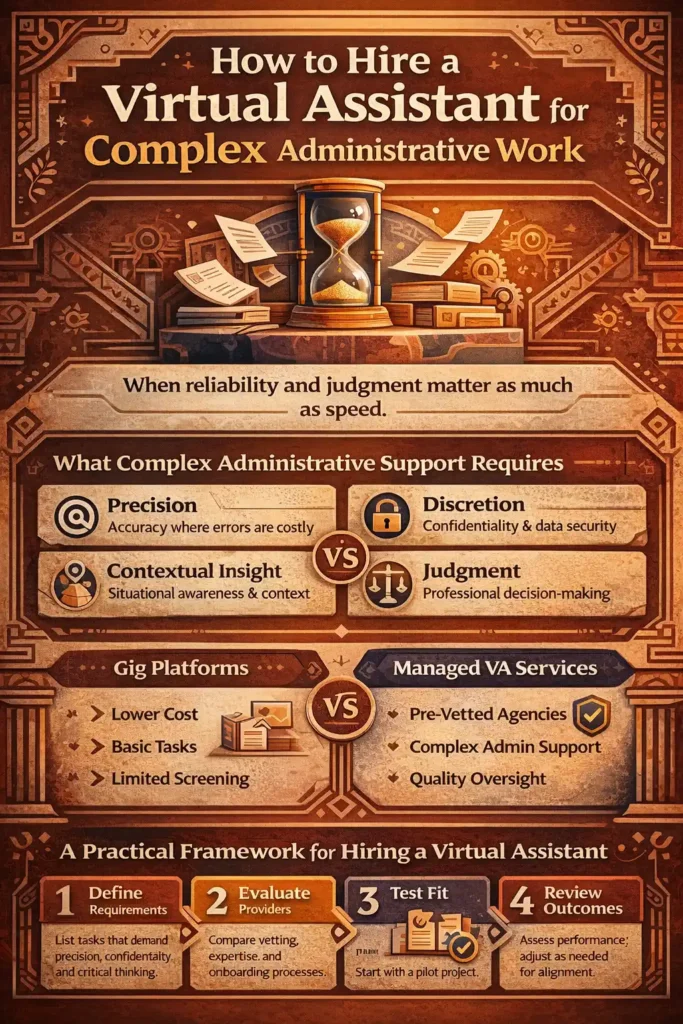
Why the Standard Approach to Hiring Virtual Assistant Services Often Falls Short
Most hiring advice for virtual assistants defaults to the same playbook: post a job description on a freelance marketplace, review some profiles, run a quick trial task, and get started. For straightforward administrative tasks, that approach can work. For complex, sensitive, or document-intensive work, it routinely leads to frustration.
The core problem is that marketplaces are built for volume and speed, not fit and reliability. When you need someone who can draft a client-facing memo, manage a sensitive contract workflow, or support a high-stakes research project, you’re not looking for the most affordable candidate in a large pool. You’re looking for someone with specific experience, professional standards, and communication skills to do the work without hand-holding.
There are also structural issues with the self-directed approach. Vetting is entirely your responsibility. You’re screening resumes, running interviews, assigning test tasks, and following up—which consumes time you don’t have. If the hire doesn’t work out, you start over. And because most freelance marketplaces have minimal quality controls, the variance in what you find is enormous.
The alternative is working with a specialist provider—whether a dedicated virtual assistant company or a boutique virtual assistant agency—that pre-vets talent, manages the matching process, and takes accountability for quality. This costs more per hour than a cold hire from a freelance platform, but when you account for the time spent recruiting, onboarding, and managing quality issues, the economics often favour the structured approach.
There’s a more fundamental question underneath all of this: what problem are you actually trying to solve? The answer shapes every subsequent decision—what type of support you need, where to find it, how to structure the engagement, and what success looks like.
How to Hire a Virtual Assistant: A Practical Framework
Before posting a job description or contacting any agency, the most valuable thing you can do is clarify your own requirements. This sounds obvious, but most hiring processes for virtual support fail because the brief is vague. ‘I need help with admin’ is not a useful starting point. ‘I need someone to manage client correspondence, prepare meeting summaries, and maintain our CRM records—handling roughly 15 hours of work per week’ is.
Step One: Define the Work, Not the Role
Start with a concrete inventory of what you want to delegate. Think in terms of tasks, not job titles. Write down the specific things you’re currently doing that you shouldn’t be doing, and estimate how much time each takes per week. Include the tools involved (CRM, project management software, document platforms), the level of judgment required, and whether each task involves confidential information.
This exercise serves two purposes. First, it clarifies how much support you actually need—which affects whether you’re looking for part-time help, a dedicated assistant, or a team with backup coverage. Second, it gives any prospective VA or agency a clear picture of the scope, which allows for more accurate matching and more realistic expectations on both sides.
Step Two: Decide on the Sourcing Model
There are three main routes for finding virtual assistant services: freelance marketplaces, dedicated VA companies, and specialist boutique agencies.
Freelance marketplaces offer access to a large pool of candidates at a wide range of price points. The trade-off is that vetting is entirely your responsibility, quality consistency is uncertain, and there’s no backup if your assistant is unavailable. This model can work well for project-based work or for businesses with the bandwidth to manage the hiring process carefully.
Dedicated VA companies occupy a middle ground. They handle initial vetting and typically offer some form of replacement guarantee. The quality bar is more consistent than a marketplace, though the matching process can be less tailored.
A boutique virtual assistant agency operates differently. Smaller in scale by design, these firms typically accept a fraction of applicants, focus on a specific client profile or industry, and take a more hands-on approach to matching and account management. For executives and professionals who need complex, sensitive support, the boutique model often delivers a better fit—because the agency’s business depends on getting that match right every time, not on processing volume.
The dedicated monthly VA segment is expected to command over 53% share in the global virtual assistant services market in 2025—a figure that reflects a clear preference among business clients for ongoing, structured relationships rather than one-off project hiring.
Step Three: Vet for the Right Indicators
When evaluating candidates or agency matches, the most important signals are not always the most visible. Years of experience matters less than the specific nature of that experience. A VA who has spent five years on social media scheduling has a different capability profile than one who has spent five years supporting a law firm’s document management or a consultancy’s executive team.
For complex work, prioritise:
- Industry proximity—has the candidate worked in environments like yours, with similar documentation, communication standards, or confidentiality requirements?
- Communication quality—not fluency alone, but professionalism; the quality of their written responses is a direct signal of the work they’ll produce on your behalf.
- Systems literacy—can they work in the tools you use, or will onboarding require significant investment?
- Discretion and professionalism—assessed through references, agency vetting standards, and a structured trial task.
Step Four: Structure the Onboarding
Even the best virtual assistant needs a structured onboarding. Prepare documentation for the key processes you’re delegating—how you like correspondence drafted, the tone you use with different clients, the systems they’ll need access to, and how you want updates communicated. This upfront investment pays dividends immediately and reduces the friction that derails many VA relationships in the first few weeks.
Set a clear review cadence for the first month. Short, regular check-ins—even 15 minutes twice a week—allow you to course-correct quickly and build shared understanding of priorities and standards.
Use Cases: When to Hire a Virtual Assistant for Complex Work
The range of professionals who benefit from specialist administrative support is broader than it might appear. A few patterns are worth understanding.
Executive and Leadership Support
Senior executives and founders often have the most fragmented time in any organization. Their administrative burden—managing stakeholder communications, preparing briefings, coordinating schedules across multiple time zones, handling board-level correspondence—requires a VA who can operate at a professional level, not just a logistical one. Around 42% of executives use virtual assistants to manage their daily tasks, ensuring they stay focused on core responsibilities. The right support at this level functions less like a task executor and more like a junior chief of staff operating in the background.
Consultants and Agencies
Consulting firms and boutique agencies often run on tight margins with lean teams. Proposal preparation, research compilation, client reporting, and document formatting are all tasks that consume billable time without generating it. Delegating this work to a skilled VA—particularly one with experience in the industry—directly improves utilisation rates and output quality.
Legal, Financial, and Research Professionals
Document-heavy professions have particularly high requirements around accuracy, formatting, and confidentiality. A VA supporting a lawyer or financial advisor isn’t just managing a calendar—they’re preparing client-facing documents, maintaining compliance records, and handling sensitive information that requires genuine discretion. About 54% of companies use virtual assistants for administrative support, while 42% rely on them for project management tasks.
Small Business Owners with Operational Complexity
Not every small business needs basic admin support. Some—particularly in professional services, healthcare-adjacent sectors, or technical fields—need someone who can manage complex vendor relationships, coordinate multi-party projects, maintain sophisticated documentation systems, and communicate professionally with clients. The volume of work may not justify a full-time hire, but the complexity certainly justifies going beyond a low-cost marketplace solution.
Remote and Distributed Teams
Businesses operating across multiple time zones often need administrative coverage that extends beyond a single person’s working hours. A VA hired through a specialist service can provide continuity across time zones, handle morning-of coordination in one region while the core team is offline, and ensure that nothing important falls through the gaps in a distributed workflow.
Market Context: What’s Changed and What It Means for Buyers
The virtual assistant market has matured considerably. The global virtual assistant services market grew from around $12.3 billion in 2020 to $18.1 billion in 2024, driven by service-centric adoption. That growth reflects a meaningful shift in how businesses think about administrative support—not as a stopgap for when things get too busy, but as a deliberate structural choice.
Several things have changed that matter for buyers today.
The quality gap between providers has widened. As the market has grown, the difference between commodity VA services and professional-grade support has become more pronounced. Low-cost providers offer lower cost; specialist firms offer genuinely different capabilities. The challenge is identifying which category you’re dealing with before you commit.
AI has changed what VAs actually do. About 45% of administrative tasks are expected to be automated by 2025, driving virtual assistants to focus more on strategic tasks requiring human judgment. The most capable VAs today are not competing with AI tools—they’re using them. A skilled assistant who leverages AI for research compilation, draft generation, and document formatting can deliver significantly more output per hour than one working without those tools. When evaluating virtual assistant services, it’s worth asking how they approach AI integration.
Confidentiality has become a more prominent concern. As VAs handle increasingly sensitive work—legal documents, financial data, executive communications—data security has moved from a background consideration to a foreground one. More than 45% of surveyed users express hesitation about sharing sensitive data with assistants, a figure that reflects a legitimate concern, not just anxiety. Reputable agencies address this through NDAs, secure communication protocols, and defined access policies.
Hybrid models are gaining traction. Hybrid VA models combining human and AI support were adopted by 27% of Fortune 1000 firms in 2024. For complex administrative work, this makes intuitive sense: the judgment, communication, and relationship-awareness that define high-quality support remain human, while AI handles the more mechanical layers.
Specialisation is increasingly the norm. A survey by Statista found that 62% of companies are hiring VAs with specialised skills to improve operational efficiency. When you hire a virtual assistant for complex work, you’re not looking for someone who can do anything—you’re looking for someone with deep experience in your specific category of need.
Expert Decision Factors: What Serious Buyers Should Evaluate
After the sourcing and interview process, a few specific decision factors consistently separate successful VA relationships from disappointing ones. These aren’t always discussed in the standard hiring playbook, but they matter enormously for complex work.
Judgment Under Ambiguity
Complex administrative tasks frequently involve situations that weren’t anticipated in the original brief. A strong VA handles ambiguity by making a reasonable call and communicating it, rather than stalling. A weaker one either acts without flagging the issue or freezes and waits for instructions. During evaluation, give candidates scenarios that require this kind of judgment and observe how they respond.
Communication Style, Not Just Communication Skill
Fluency is necessary but not sufficient. For work that involves drafting on your behalf, communicating with your clients, or representing your organisation in writing, you need someone whose style is professionally compatible with yours. Ask to see writing samples. Run a drafting test with a realistic brief. The gap between someone who can write clearly and someone who can write the way you need them to write is often significant.
Reliability Architecture
What happens when your VA is sick, on holiday, or dealing with an emergency? For a freelancer, the answer is usually that nothing gets done. For a VA company or boutique virtual assistant agency, the answer should involve a coverage plan—whether that’s a backup assistant, a handoff process, or a dedicated account manager who manages continuity. For professionals who have built their workflows around external support, this reliability question is not a minor operational detail.
Pricing Structure Transparency
VA pricing ranges widely. Costs typically run from $5 to $50 or more per hour, with basic administrative tasks at the lower end and expert-level work at the higher end. What matters as much as the rate is how it’s structured—whether you’re paying for hours worked, a monthly retainer, a task-based package, or something else. Ambiguity in pricing leads to scope disputes. A reputable provider should be able to explain clearly what you’re paying for and what’s included.
Cultural and Operational Fit
This is particularly relevant for professionals who want support that feels like an extension of their own team rather than an external contractor. The best VA relationships involve someone who understands your business, your communication preferences, your standards, and your priorities without requiring constant re-explanation. This fit takes time to develop—but the foundations of it should be visible in the first few weeks.
Confidentiality Commitments
Before any sensitive information is shared, this should be addressed explicitly. Are NDAs standard? What data security practices does the provider follow? How is access to proprietary systems managed? Any reputable service should have clear answers to these questions. If the answers are vague, that’s a signal worth taking seriously.
Common Mistakes and Misconceptions
Even professionals who make thoughtful hiring decisions often stumble on predictable issues. Understanding these patterns in advance can save significant time and frustration.
Hiring for cost before fit. The most common mistake in this category is treating VA hiring like commodity procurement—optimising for the lowest hourly rate without accounting for the total cost of managing quality, rework, and re-hiring. For complex work, a more expensive but well-matched VA typically delivers better value than an inexpensive one who requires constant supervision.
Delegating without documentation. Handing over complex tasks without any process documentation creates predictable problems. The VA doesn’t know your preferences, your standards, or the context behind what they’re being asked to do. The result is a lot of back-and-forth, work that misses the mark, and frustration on both sides. Invest time upfront in building basic SOPs (standard operating procedures) for recurring tasks.
Expecting immediate autonomy. Even exceptional VAs need a ramp-up period with complex work. Two to four weeks of more intensive guidance—where you’re reviewing output, providing specific feedback, and building shared understanding—is a reasonable investment for a role that will then operate independently for months or years.
Conflating AI tools with AI replacement. Some business owners have experimented with AI tools as a substitute for human VA support. For complex administrative work—especially anything involving judgment, relationship management, or sensitive communication—AI tools remain supplements to capable human support, not replacements.
Skipping the trial period. Most reputable virtual assistant services offer some form of trial or probationary structure. Use this period seriously—assign representative tasks, observe communication, and assess whether the working relationship has the right dynamics before you deepen the engagement.
Treating the VA relationship as a transaction. The professionals who get the most from virtual assistant services tend to treat the relationship as a genuine working partnership—providing context, giving feedback, and investing in the VA’s understanding of their business. Those who treat it purely transactionally typically get transactional results.
Practical Guidance: How to Hire a Virtual Assistant the Right Way
If you’ve read this far, you probably have a clearer sense of what you need than when you started. Here’s a summary of the most important decisions:
Start with clarity, not job postings. Before engaging any service or marketplace, document the specific tasks you want to delegate, the tools involved, the sensitivity of the work, and the hours per week you’re expecting. This document becomes the foundation for every subsequent conversation.
Match the sourcing model to the complexity. For routine tasks and project-based work, a freelance marketplace can be a cost-effective option. For ongoing, complex, or sensitive administrative support, a dedicated VA company or boutique virtual assistant agency offers meaningfully better risk management and quality consistency.
Assess confidentiality infrastructure seriously. If your work involves sensitive client information, financial data, legal documents, or proprietary business intelligence, make data security a primary evaluation criterion—not an afterthought.
Invest in onboarding. The first month of any VA relationship shapes the quality of everything that follows. Prepare documentation, schedule regular check-ins, and treat the ramp-up period as a worthwhile investment.
Revisit and refine. The best VA relationships evolve. As you build trust and shared understanding, you’ll typically find you can delegate more—and that the quality and efficiency of support improves as the VA develops a deeper understanding of your work.
The professionals who benefit most from virtual support are not necessarily those with the biggest budgets or the most complex workflows. They’re the ones who approach the hire with clarity, choose their sourcing model deliberately, and invest in the relationship with the same care they’d bring to any important business decision.
When the fit is right, the result is not just time saved—it’s the kind of focused, uninterrupted attention to the work that actually matters, which is harder to put a number on but easy to feel.