The Hours You’re Losing—and Why They Matter
There’s a version of your Tuesday that goes like this: you arrive at your desk intending to work on strategy, client delivery, or business development. Instead, you spend forty minutes rerouting email threads, another half-hour rescheduling a meeting that should have been handled yesterday, and most of your afternoon buried in document preparation that someone else could have managed with reasonable instruction and trust.
This isn’t a productivity failure. It’s a structural one.
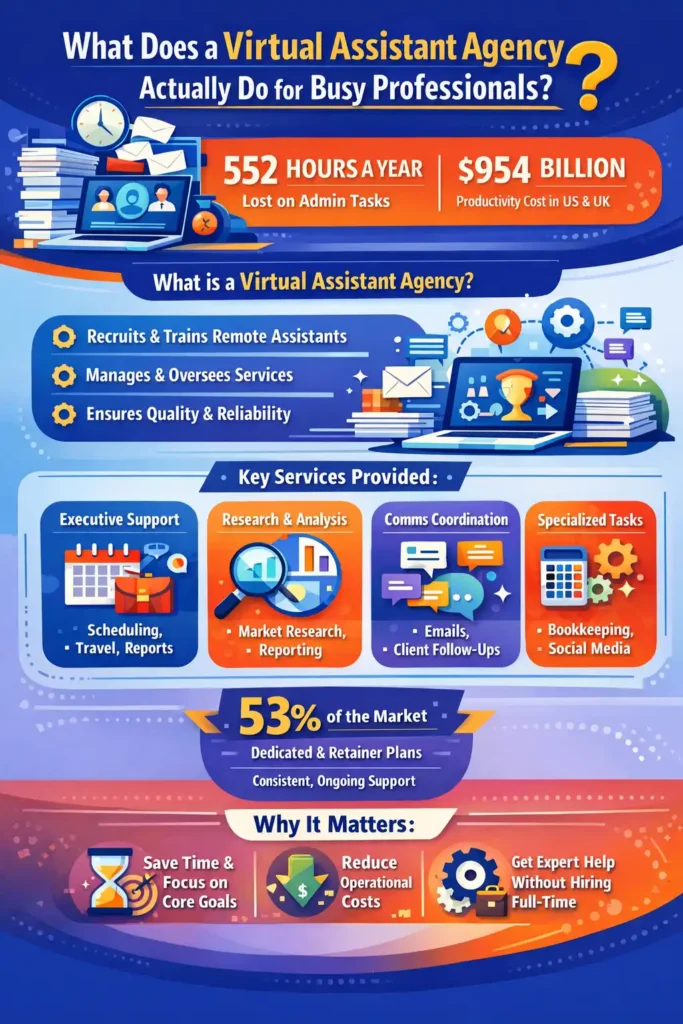
Research by Unit4 found that office workers across 11 countries spend an average of 552 hours annually—roughly one-third of the working year—on administrative or repetitive tasks. A more recent survey of UK and US office workers, published in early 2026, estimated the productivity cost of avoidable admin at $954 billion annually across both countries combined.
These aren’t outlier figures. They reflect a predictable pattern: as professionals scale their work and influence, the volume of supporting tasks grows faster than their capacity to manage it. Email, scheduling, research, document formatting, inbox triage, travel coordination, data entry—none of it is trivial, but almost none of it requires your specific expertise.
That’s precisely the gap that virtual assistant services are built to fill. And understanding what a virtual assistant agency actually does—not in abstract terms, but in practical, operational ones—is the first step toward deciding whether this kind of support belongs in your workflow.
What a Virtual Assistant Agency Actually Is
The term “virtual assistant” has accumulated a lot of noise over the past decade. It describes everything from AI chatbots to offshore freelancers to premium executive support services. Sorting out what a virtual assistant agency specifically offers—versus a freelance platform, a staffing firm, or a software tool—is worth doing carefully.
A virtual assistant agency is a service organization that recruits, vets, trains, and places remote assistants with clients, then manages the ongoing employment or contractor relationship on the client’s behalf. The client doesn’t interview candidates from a marketplace and hope for the best. They engage with a structured provider that handles the supply chain of talent: sourcing, background screening, skill assessment, onboarding, quality control, and, when necessary, replacement.
This model distinguishes an agency from a freelance marketplace like Upwork or Fiverr, where the client bears full responsibility for hiring decisions, vetting credentials, managing performance, and replacing assistants who drop off. It also differs from traditional staffing agencies, which typically place workers in physical offices with employment contracts tied to the client.
The agency model—particularly the subscription or retainer-based version—has become the dominant format in the professional virtual assistance market. Dedicated monthly arrangements now account for roughly 53% of market revenue, according to industry analysis for 2025, reflecting a preference among businesses for continuity and predictable outcomes over ad hoc, project-by-project sourcing.
What this means practically is that when you engage a virtual assistant agency, you’re not just hiring a person. You’re buying into a support infrastructure: a managed process, a backup system, a quality standard, and a relationship designed to work at volume over time.
For a busy founder, consultant, or executive, that distinction matters considerably. The goal isn’t to find a good virtual assistant. The goal is to build reliable, repeatable administrative capacity—without the overhead of full-time employment, benefits, or HR management.
The Scope of Services: Broader Than Most People Expect
One common misconception is that virtual assistant agencies handle only basic clerical work—calendar management, email replies, data entry. In reality, the scope of modern administrative support services has expanded substantially.
The most capable agencies now offer tiered assistance across several functional areas:
Executive and administrative support: Calendar management, inbox organization, meeting preparation, travel coordination, expense reporting, and document preparation. This category remains the most in-demand, representing approximately 38% of market demand in 2025.
Research and knowledge work: Competitive research, sourcing briefings, summarizing reports, preparing presentation materials, and supporting due diligence workflows.
Communications and coordination: Drafting correspondence, managing follow-up sequences, coordinating between teams or stakeholders, and handling routine client communication.
Specialized operational support: Bookkeeping assistance, CRM data management, social media scheduling, content formatting, project coordination, and light customer service.
Industry-specific support: Legal and medical professionals increasingly use dedicated virtual assistants familiar with the terminology, documentation standards, and confidentiality requirements of their fields.
The breadth available depends on the agency. Some operate as generalist providers with teams trained across common business functions. Others specialize by industry, workflow type, or skill set. Neither model is universally better—fit depends on the nature and volume of work being delegated.
Infographic of What Does a Virtual Assistant Agency Actually Do for Busy Professionals
How Virtual Assistant Services Work in Practice
Understanding the operational mechanics of virtual assistant services helps set realistic expectations and improves the likelihood of a successful engagement.
Onboarding and Scoping
Most reputable agencies begin with a discovery or intake process designed to understand the client’s workload, communication style, tools used, and delegation priorities. This isn’t a formality—it’s the foundation for matching the right assistant to the right professional.
The quality of this intake process is often a reliable indicator of an agency’s overall standards. Agencies that rush into placement without understanding the client’s workflow tend to produce poor matches, which then require time-consuming restarts.
After scoping, the agency proposes an assistant—or sometimes, in team-based models, a small group of specialists. The client reviews relevant experience, and in most cases, has input on the selection before an engagement begins.
Communication and Tools
virtual assistant relationships typically operate through a combination of task management platforms (Asana, Trello, ClickUp), communication tools (Slack, email, video calls), and shared document environments (Google Workspace, Microsoft 365, Notion). The assistant integrates into whatever stack the client already uses, or the agency recommends a lightweight setup for clients without existing systems.
Daily communication cadence varies. Some clients prefer brief asynchronous check-ins; others run structured weekly handoff calls. The point is that the relationship operates on the client’s terms—the assistant adapts, not the other way around.
Quality Control and Continuity
A structural advantage of agencies over freelancers is the backup model. When your dedicated assistant is unavailable due to illness, personal leave, or turnover, a professional agency provides a trained replacement who can pick up ongoing tasks without disruption. This is possible because agencies maintain documentation of client workflows, SOPs, and preferences—meaning continuity isn’t dependent on any single individual.
Freelancers typically cannot offer this. A solo operator’s absence translates directly into your tasks going undone, with no escalation path and no guaranteed timeline for resolution.
Confidentiality and Data Security
Document-heavy and sensitive-workflow professionals—lawyers, financial advisors, consultants, researchers, executives—often raise legitimate concerns about confidentiality when considering remote assistance. Established agencies address this through signed NDAs, data handling policies, vetted assistants, and in some cases, jurisdiction-specific compliance frameworks.
Freelance platforms provide far weaker protections in this area. Agreements are informal, vetting is shallow, and there’s no institutional accountability for data handling. For professionals managing sensitive client information or intellectual property, this difference is material.
The Use Cases That Make Virtual Assistant Services Worth It
Not every professional is equally suited to benefit from a virtual assistant agency. The value proposition is strongest in situations where administrative volume is high, task variability is manageable, and the cost of the professional’s distracted time is significant.
High-Volume Executives and Founders
A founder managing rapid growth often finds that operational and administrative tasks expand in direct proportion to the business. As revenue climbs, so does the volume of vendor coordination, scheduling complexity, inbox volume, and document management. The economics here are clear: if an executive’s time is worth $200 per hour and they’re spending 20 hours a month on work a capable assistant could handle for a fraction of that cost, the delegation case writes itself.
The challenge is usually trust, not cost—and that’s where a structured agency helps. The vetting and management layer reduces the risk of poor delegation outcomes.
Consultants and Independent Professionals
Solo practitioners and consultants face a particularly acute version of this problem. Unlike employees in large organizations who can rely on internal support staff, independent professionals carry the full administrative load themselves. Research, proposal writing, scheduling, invoicing, client communication—all of it lands on one desk.
Engaging a virtual assistant agency gives consultants access to part-time professional support calibrated to their actual workload, without committing to a full-time hire. Subscription models make the cost predictable; the flexible structure allows scaling up during busy periods and pulling back during quiet ones.
Agencies and Professional Services Firms
Small agencies—marketing, PR, design, legal, financial advisory—often operate with lean teams where senior staff routinely perform tasks below their skill level because there’s no one else to absorb them. A client services director shouldn’t be formatting proposals or updating CRM records; a virtual assistant can handle both.
Agencies also benefit from team-based VA models, where different assistants cover different functional areas—one handling administrative coordination, another focused on research or content preparation—without the overhead of additional full-time headcount.
Researchers and Document-Heavy Professionals
Academics, analysts, compliance officers, and researchers often deal with heavy documentation workflows: literature reviews, data organization, citation management, report formatting, and regulatory filing preparation. Many of these tasks require care and accuracy but not specialist knowledge—precisely the kind of work a well-trained assistant can handle with proper instruction and a clear SOP.
Executives in Transition or Under Elevated Load
Business owners going through M&A activity, strategic pivots, funding rounds, or major client deliverables often face temporary spikes in administrative demand that exceed what their regular team can absorb. A virtual assistant agency can provide rapid-onboard support for defined periods without requiring long-term staffing commitments.
The Market Behind the Demand
The commercial infrastructure supporting virtual assistant services has matured considerably over the past several years. The global market for human-delivered virtual assistant services was valued at roughly $18 billion in 2024 and is projected to reach approximately $19.5 billion in 2025, growing toward $55 billion by 2035 at a compound annual growth rate of around 11%.
These numbers reflect human-delivered assistance—the kind a virtual assistant agency provides—rather than AI software platforms, which follow a separate (and far faster-growing) trajectory. The human assistance market’s growth is steadier and demand-driven, fueled by the ongoing normalization of remote work, the proliferation of small and mid-size businesses seeking flexible staffing, and rising recognition among professionals that delegation is not a luxury but a competitive necessity.
Small and medium-sized businesses represent approximately 44% of market demand, according to 2025 industry analysis. This reflects a structural shift: professional support services, once accessible primarily to large corporations with full-time executive assistants and dedicated admin teams, are now within reach of individual consultants, small agencies, and founder-led companies through subscription-based virtual assistant models.
The geographic spread is also notable. While North American demand remains strong—driven by high hourly rates that make delegation economics especially compelling—growth in Asia, Latin America, and Europe reflects the genuinely international character of modern remote work. A well-structured agency can place skilled assistants in compatible time zones regardless of where either party is located.
What does this tell a prospective buyer? That they’re entering a mature, professionalized market—not a loosely organized gig economy. Pricing has become more transparent, quality tiers more clearly defined, and service models more sophisticated than even five years ago.
How Pricing Typically Works
Agency pricing operates through a few common models:
Monthly retainers or subscription packages — the most common format, where a client pays a flat fee for a defined number of hours or a dedicated part-time assistant. Rates typically range from $15 to $50 per hour for agency-managed VAs, depending on specialization, experience level, and the agency’s overhead structure.
Project-based packages — one-time engagements for defined scopes of work, often priced between $500 and $2,000 or more depending on complexity.
Dedicated full-time arrangements — increasingly available for clients who need consistent, high-volume support and want the equivalent of a full-time remote assistant without the employment infrastructure.
Freelance VAs, by comparison, typically charge between $5 and $25 per hour. The lower end reflects offshore providers with strong technical skills but less infrastructure behind them. The pricing differential between freelancers and agencies reflects the managed layer: vetting, training, backup coverage, quality control, and contractual accountability.
For clients with significant recurring administrative needs, the agency premium usually pays for itself in reduced management overhead, lower replacement friction, and more reliable output quality.
What Serious Buyers Should Evaluate Before Engaging
Choosing a virtual assistant agency isn’t simply a matter of comparing price points. The decision involves assessing several dimensions of fit, quality, and operational alignment.
Vetting and Quality Standards
Ask how the agency sources and screens its assistants. What does the selection process look like? What percentage of applicants are accepted? What skills are assessed, and how? Agencies with rigorous vetting processes should be able to describe them in concrete terms—not just claim they hire “the best talent.”
Credentials, prior work samples, references, and background checks are all reasonable to expect. If an agency is vague about how it evaluates its assistants, treat that as a signal.
Specialization Versus Generalism
Some agencies build deep expertise in specific industries or functions—legal support, medical administration, e-commerce operations, financial services. Others train generalists capable of handling diverse administrative tasks across industries. The right choice depends on your workflow.
For standard executive or administrative support, a well-trained generalist is often sufficient. For professionals with specialized documentation requirements, terminology-sensitive tasks, or industry-specific compliance obligations, a specialized provider is worth the added search time.
Communication and Management Structure
How does the agency communicate with you about performance, issues, and changes? Is there a dedicated account manager? What’s the escalation process if something goes wrong? These operational details matter as much as the assistant’s individual skills.
The best agencies treat client relationships as partnerships, not just placements. They proactively surface problems, suggest process improvements, and adapt as client needs evolve.
Confidentiality Architecture
Review the NDAs and data handling policies before signing. Understand who has access to what, how data is stored, and what protocols govern sensitive material. For professionals handling client confidential information, this review isn’t optional—it’s due diligence.
Trial Periods and Flexibility
Most established agencies offer a trial period or structured onboarding phase with built-in evaluation checkpoints. Use these. The first few weeks of any virtual assistant relationship require active feedback to calibrate expectations and refine workflows. Agencies that build this into their process typically produce better long-term outcomes than those that treat placement as the finish line.
What People Get Wrong About Hiring Virtual Support
Misaligned expectations are the most common source of disappointment when professionals engage virtual assistant services. Several persistent misconceptions are worth addressing directly.
“I’ll save time immediately.” The first two to four weeks of a virtual assistant engagement typically require more of your time, not less. Documenting processes, providing feedback, and clarifying standards are investments—they pay back significantly, but not on day one. Professionals who approach onboarding impatiently often undermine engagements that would have worked with a little more initial structure.
“I just need someone cheap to handle the small stuff.” This framing produces poor outcomes. The professionals who get the most value from virtual assistant services are those who treat delegation as a strategic decision—who invest time in identifying high-leverage tasks, providing clear context, and building a genuine working relationship with their assistant. Treating an assistant as a low-cost task dumping ground produces exactly the results that give outsourced support a bad reputation.
“Any VA is the same.” Skill range, cultural fit, communication style, and specialization vary enormously. An assistant excellent at research and document preparation may be weaker at client-facing communication. One skilled in financial services terminology may struggle with technical product documentation. Matching the right assistant profile to the actual workflow is a critical part of the agency’s value—but it requires the client to be honest and specific about what they actually need.
“An agency is just a more expensive freelancer.” This comparison misunderstands what the agency layer provides. It’s not just markup on talent. It’s risk mitigation, continuity insurance, accountability structure, and management infrastructure. For professionals who depend on their support system actually working, that structure has real value—particularly when measured against the cost and friction of replacing a freelancer who disappears mid-project.
“I don’t have enough work for a full-time assistant.” This is often the opposite of the problem. Most virtual assistant agencies offer part-time packages starting at 10–20 hours per month. The subscription model exists precisely for professionals who don’t need a full-time hire but whose administrative load exceeds what they can absorb without cost to their higher-priority work.
How to Actually Get Started
The path from considering virtual assistant services to actually benefiting from them is shorter than most professionals expect—but it requires deliberate preparation to work well.
Start by auditing where your time actually goes. Spend one week tracking tasks in 30-minute increments. Identify everything that consumed your attention and ask, honestly, which of those tasks required your specific expertise, judgment, or relationships—and which didn’t. The second category is your delegation list.
From that list, identify the tasks with the highest frequency or the most friction: recurring calendar conflicts, email backlog, research requests, document formatting, follow-up sequences. These are your starting points for delegation—not because they’re unimportant, but because they’re solvable with good instruction and a capable assistant.
Then evaluate agencies on the dimensions outlined above. Request a consultation; most reputable providers offer one without commitment. Use it to assess not just the service but the people behind it—how they listen, how they ask questions, and whether they seem to understand the kind of professional you are and the kind of support you actually need.
A well-matched virtual assistant agency doesn’t just clear your inbox. It restructures your relationship with your time—shifting your attention toward the work that compounds, and away from the work that merely consumes.
The market has matured enough that high-quality administrative support services are accessible to professionals at almost every business stage, budget, and location. The question is no longer whether this kind of support is real or reliable. It’s whether the cost of not having it—in distraction, delay, and deferred growth—has become too high to ignore.
For most busy professionals who have done the honest accounting, the answer turns out to be yes.